Don't Break Your Crochet Machine
Discover the best way to clean and grease your Sentro or Addi crochet machines. We tested the top lubricants to keep your machine running smooth and silent.
MAINTENANCEHOW TO
Stanley
12/25/20253 min read

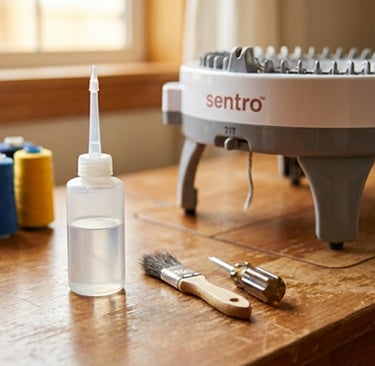
The Ultimate Guide to Cleaning and Greasing Your Sentro or Addi Crochet Machines
There is a specific sound that haunts every machine knitter's nightmares.
It isn't the sound of a dropped stitch. It is the sound of a dry machine.
It starts as a high pitched squeak. Then, it becomes a gritty feeling in the handle. Finally, it turns into a loud, rhythmic CRUNCH-CRUNCH-CRUNCH as you turn the crank.
If you hear this, stop immediately.
Your machine is crying out for help. Most knitting machines—whether it’s the budget-friendly Sentro 48 or the premium Addi Express are shipped from the factory with very little lubrication. Over time, yarn dust (lint) mixes with the plastic gears to create a sticky friction that can strip the teeth right off your handle.
The good news? You can fix it in 15 minutes. Here is the ultimate guide to preserving your investment.
The "Do NOT Use" List (Read This First!)
Before you grab whatever spray is in your garage, you need to know what destroys these machines. These products will melt, degrade, or gum up the plastic gears.
WD-40 (Standard Blue Can): NEVER. WD-40 is a solvent, not a lubricant. It will eat away at certain plastics over time and eventually make the plastic brittle and prone to shattering.
Cooking Oil (Olive/Vegetable): It will go rancid and smell terrible. It also attracts ants.
Vaseline (Petroleum Jelly): It is too thick and sticky. It acts like a magnet for yarn dust, creating a "sludge" that will jam your machine harder than before.
The Only Lubricants You Should Use
Plastic gears require specific synthetic greases that reduce friction without chemically attacking the material.
1. The Gold Standard: Super Lube PTFE Grease
If you only buy one thing, make it Super Lube 21030. This is a synthetic grease with Syncolon (PTFE/Teflon). It is food-safe, plastic-safe, and incredibly slick.
Why we love it: It doesn’t dry out, and it is thick enough to stay on the gears but thin enough not to create drag.
2. White Lithium Grease
This is a solid runner-up. It is safe for plastic-on-plastic contact. However, it can be a bit messier than Super Lube.
3. Sewing Machine Oil (For Needles Only)
You should not use this on the big gears (it is too thin and will drip out the bottom), but it is perfect for the metal needles themselves.
Step-by-Step: The 15-Minute Tune-Up
You don’t need to be an engineer to do this. If you can use a screwdriver, you can service your machine.
Tools Needed:
Precision Screwdriver Set: The screwdriver that comes with the Sentro is often too short or strips easily. You need a long, thin Phillips head.
Canned Air: To blow out the lint.
Microfiber Cloth: To wipe away old grime.
The Grease: (See above).
Step 1: The "Open Heart" Surgery
Flip your machine upside down.
Remove the suction cups (if attached).
Locate the screws around the outer ring.
Warning: Sentro screws are deep. Use a magnetic screwdriver if possible so you don’t lose them inside the casing.
Gently lift the bottom ring off.
Step 2: The "Fluff" Removal
You will likely be shocked by what you find inside. Yarn creates a fine dust that settles into the gear teeth.
Take your Canned Air or a clean paintbrush and sweep out every speck of dust.
If you see black dust, that is plastic shavings from your gears grinding. That means you waited too long—clean it out and grease it immediately!
Step 3: Greasing the Tracks
You do not need to drown the machine. "A little dab will do ya."
Apply a pea-sized amount of Super Lube to the main "teeth" of the large ring gear.
Apply a thin film of grease to the "track" where the needles slide up and down.
Do not grease the yarn counter sensor (the little magnetic trigger). Keep that clean and dry.
Step 4: Reassemble and Test
Put the cover back on and screw it tight (but not too tight, or you’ll crack the plastic). Turn the crank. It should feel buttery smooth and silent.
Future-Proofing: The "Survival Kit"
Maintenance isn't just about cleaning; it's about preparation. Parts will break eventually, usually in the middle of a project you need to finish by tomorrow.
To avoid panic, keep this small "Survival Kit" in your crafting drawer:
Spare Needles: Sentro and Addi needles are different sizes. Buy a 10-pack specific to your machine now. One bent needle can ruin an entire beanie.
Replacement Handle: If you use a drill adapter, you are putting extra torque on the handle shaft. It is the most common part to snap.
Digital Counter Batteries: The Sentro counter usually takes LR44 batteries. They always die when you are at row 98 of 100.
By keeping your machine greased and your spare parts ready, you turn a potential disaster into a minor 5-minute pit stop.
Contact
hello@crochetmachines.com
© 2025. All rights reserved.